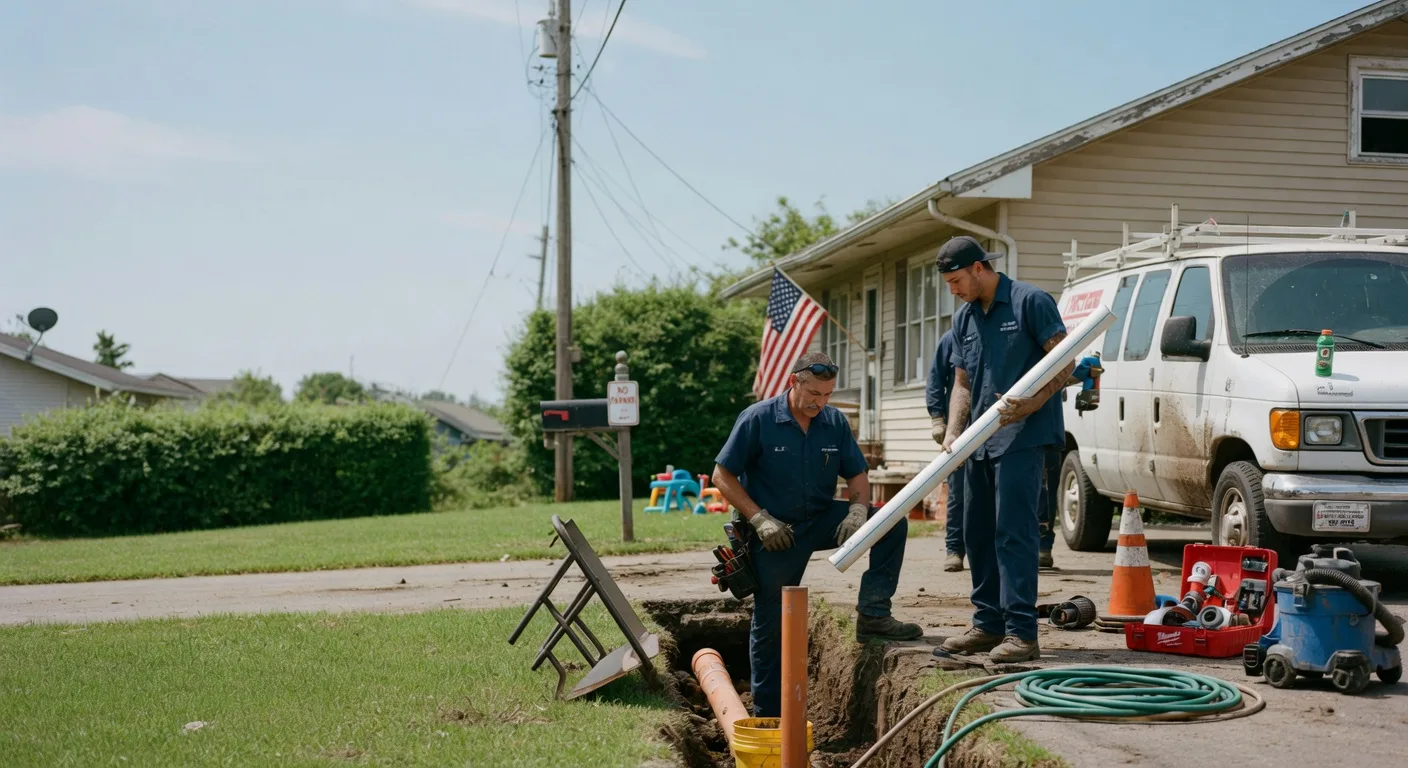
What is a cleanout and why does the plumber keep asking if I have one?
A cleanout is a capped pipe fitting that gives a plumber direct access to the sewer line. It usually looks like a round plug, three or four inches across, sitting on a short stub of pipe. You will often find one in the basement near the main stack, in a crawlspace, along an outside wall or in the yard near the foundation.
The plumber asks because it decides how the job is done. With a cleanout, a cable machine or hydro jetter goes straight into the line. Without one, the equipment has to go in through a toilet, a floor drain or the roof vent. That can mean pulling a toilet, and it limits how far the machine travels and how well a camera can see.
Safe homeowner check: find the cap and note where it is. Do not unscrew it if the house drains are backed up. Water can be standing behind the cap, and it will come out.
Stop running water and call now if the cleanout is wet or leaking, or if several drains in the house are backing up together. That points to a blockage in the main line.
If your home has no cleanout, adding one is often part of the job. What it costs depends on access, how deep the line is, how much has to be dug or cut open, and whether a permit applies.
Expert Plumbers Co is a referral service. Call (380) 262-9173 and we will connect you with a plumber serving Otis, LA for Drain Cleaning.
A few practical points help when a cleanout is involved. The cap can be stuck from years of rust or paint, and forcing it with a long wrench can crack the fitting, so leave a stubborn one to the plumber. Keep the area around it clear of storage, snow, soil or landscaping so the crew can reach it quickly. In older homes the cleanout may have been buried when the yard was regraded, or covered by a patio or flooring, and finding it can take some probing. Newer homes usually have one near the foundation or at the property line, sometimes with a green or black cap flush with the lawn. If a plumber can find or install one, later cleanings and camera inspections become simpler and less disruptive, because the equipment enters the line at a planned point and nothing indoors has to be disturbed or removed.
What causes scale build-up inside old cast iron drain pipes?
Scale in cast iron is rust and mineral deposit growing on the inside wall of the pipe. Cast iron corrodes from the inside over decades. The rust forms rough lumps, called tubercles, and minerals carried in the water settle on them. Grease, soap residue and paper then catch on that rough surface and the bore gets smaller.
The homeowner sees it as drains that slow down over time, often more than one fixture at once, and gurgling when a tub or washer empties. The pipe can look fine from outside while the opening inside has shrunk to a fraction of its size.
A cable machine will punch a hole through the scale, but the water often keeps running through a narrow channel and the build-up returns. Hydro jetting strips the wall back much more completely. Before either one, a camera inspection is worth having on old iron. It shows how much scale there is and whether the pipe wall is thin, cracked or flaking, because a line that is weak can fail once the scale holding it together is cleaned off.
What the job costs depends on access, the pipe material involved, how much has to be opened up or removed, and any permit or code requirement. If sewage is backing up into the house, stop running water and call. Expert Plumbers Co is a referral service. We refer you to a local plumber for Drain Cleaning or Emergency Drain Cleaning in Otis, LA: (380) 262-9173.
A point many people miss is that cleaning scale is not always the end of the story. Once the wall is stripped back, the bare iron can start rusting again, so the line may need cleaning more than once over the years if the pipe is not replaced. Another sign it is getting worse is rusty or dark water standing in a drain that used to run clear, or small flakes of rust in a trap. In homes built before plastic pipe became common, a camera also shows whether the line is worth keeping or is near the end of its life. Pipes that are thin or cracked may need a section replaced, and that can be done in stages rather than all at once. When you call, mention the age of the house and any previous repairs to the drains, since patches in old iron often use different materials.
The laundry sink in my basement fills up when someone uses the drains upstairs. Why?
A basement laundry sink is often one of the lowest open drains in the house. When it fills with water from upstairs, that water is coming back up the main drain because the line below is blocked or too slow to carry it away.
Everything upstairs drains down through a vertical stack and into the main line that leaves the house. If that main line is partly blocked by roots at a clay joint, a bellied section holding water, or grease and wipes that have built up, the flow stops short and rises to the lowest point. That is the basement.
Check whether the floor drain, a basement toilet or a shower shows the same thing. If the laundry sink fills when you flush an upstairs toilet or run the washing machine, the main drain is the likely cause. If it only happens with the dishwasher or one bathroom, the blockage may be on a branch line instead.
Safe checks you can do: stop running water in the house for an hour and see whether the level drops. Find the cleanout, a capped pipe near the floor or outside wall, and note where it is for the plumber, but do not open it while the line is full. Do not run the washing machine or take showers to test it, and do not use chemical cleaner.
Stop all water use and call now if the water in the sink is dirty or smells, if it is rising, or if it spills over the rim. Sewage in a basement is a health hazard, so keep people and pets away and do not touch it without gloves.
A cable machine can clear a soft blockage in the main line from the cleanout. If it returns, or if the cable stops at the same spot, a camera inspection shows whether roots, a bellied pipe or a failed sewer lateral is behind it. Hydro jetting clears grease and roots more thoroughly than a cable, and a damaged line may need a repair or replacement section.
Cost depends on access to the cleanout, how far the blockage sits, whether roots or a collapsed pipe are involved, and how much has to be dug or opened.
Expert Plumbers Co can connect you with an independent local plumber in Otis, LA when you call (380) 262-9173.
What should I clear out or get ready before the plumber arrives to unclog my drain?
A little preparation saves time at the door and often means a cleaner, faster job. Most of it takes ten minutes.
Start with access. If the clog is in a sink, empty the cabinet underneath. Plumbers need to reach the trap and the wall pipe, and stored cleaning products tend to be in the way. Put a bucket and some old towels nearby. If the problem is a tub or shower, remove the rugs and anything sitting on the edge.
If the problem might be in the main line, find the cleanout. It is a capped pipe, often three or four inches across, in a basement, a crawlspace, a garage wall, or outside near the house. Clear a path to it. Move boxes, shelves and stored items, and trim back any plants hiding an outside one. If you cannot find it, tell the plumber. Do not try to unscrew an old cap with a hammer.
Pets matter more than people expect. A cable machine is loud, doors will be open, and an anxious dog or a cat slipping into a crawlspace is a real problem. Put animals in a closed room or a different part of the house.
Next, write a short list of which fixtures are affected. For example: the kitchen sink is slow, the downstairs shower gurgles, the toilet is fine. Add when it started and whether it happens only when the washer runs or when it rains. That list tells the plumber whether to look at a branch line or the main line before anyone touches a tool.
Also stop doing a few things. Do not pour chemical drain cleaner in before the visit, since it can burn skin and make the pipe unsafe to work on. If you did already, tell the plumber what you used.
Finally, if water is coming up through a floor drain or toilet right now, stop running water in the house and keep children and pets away from it. Call straight away rather than waiting to tidy up.
Cost depends on access, so a clear path to the pipe can help keep the visit short.
If you need a drain cleared in Otis, LA, Expert Plumbers Co can connect you with an independent local plumber at (380) 262-9173.
My child flushed a toy, or something solid went down the toilet. What should I do, and what should I not do?
Stop first. Do not flush again, even if the water looks like it is going down. Each flush pushes the object further along, and it can lodge in the toilet's trap or in the drain behind it. Tell everyone in the house not to use that toilet.
If the toilet still drains but the bowl is high, leave it. If it is rising toward the rim, lift the tank lid and push the flapper down, or turn the shutoff valve behind the toilet clockwise to stop more water entering.
What is safe to try: if you can see the object near the bowl opening and it is not breakable, put on gloves and pick it up. Use a wet vac or a closet auger only if you are comfortable with it, because an auger can also shove a hard toy deeper. Be gentle with a plunger. A plunger can free a soft item, such as paper or cloth, but it often wedges a solid piece tighter.
What not to do: do not use chemical drain cleaners, which do nothing to a solid object and make the water dangerous to handle. Do not keep plunging hard, and do not push a coat hanger down the drain, which can scratch the porcelain or drive the object into the pipe wall.
If the object has already gone and the toilet seems normal, watch for slow drains, gurgling or other fixtures backing up over the next few days. A small toy can catch in a bend and collect paper behind it. If the toilet becomes slow, or the same one keeps clogging, the object is probably still in the line.
In that case the plumber may pull the toilet off its seat to retrieve it from underneath, which is often cleaner than cabling into a pipe. If the item is in the drain behind the toilet, a camera can find it and the plumber can retrieve it or push it clear. Cost depends on where it lodged, whether the toilet must be removed, and how much access is needed.
Expert Plumbers Co can connect you with an independent plumber in Otis, LA for this: call (380) 262-9173.